
Decorative Face Veneers for Interior Furniture
The face veneer is the part of a panel a customer sees, and the part a competitor copies. Dongstar Wood lists five face veneers for its commercial range — Birch, Pine, Bleached Poplar, EV and Rose Eucalyptus — across four core options, and the combination a buyer picks decides how a finished cabinet, shelf or hotel fixture looks under clear lacquer.
Key takeaways
- Five face veneers, four cores: Birch, Pine, Bleached Poplar, EV and Rose Eucalyptus sit on Acacia, Bodhi, Eucalyptus or Combi cores.
- Thickness follows the furniture: 6–9 mm for cabinet backs and drawer bottoms, 12–15 mm for office furniture and shelves, 18 mm for heavy-duty work.
- Glue class matches the room: MR for dry interiors, BWR where humidity or light water exposure is expected.
- The duty position is published: the category page banner states No Anti-Dumping Tax for the EU market alongside its FSC claim.
Reading a face veneer list
The Commercial Plywood category is where the five veneers and four cores are published side by side, and in the client's own wording the range covers furniture plywood, hardwood plywood and veneer plywood. Birch gives a pale, even surface that takes stain and paint predictably. Pine is warmer and more pronounced in grain. Bleached Poplar lightens a panel for contemporary interiors. EV — engineered veneer — sorts and repairs natural veneer so the face reads uniform across a run of panels. Rose Eucalyptus adds a reddish tone for feature pieces. The list matters because furniture buyers rarely see the core: they see the face, and the face is what a showroom photographs.
Matching core to the job
The core carries the load and sets the panel's weight. Acacia Core is positioned as a high-strength hardwood with excellent density and load-bearing capacity. Bodhi Core — the client's white hardwood — offers stability and balanced mechanical strength with an eye on cost-performance. Eucalyptus Core is the maximum-strength option with high compression resistance. Combi Core mixes species, eucalyptus with acacia or hardwood with softwood, to balance strength, weight and cost. Four cores across the range means a buyer can hold the face constant and move the core up or down as the furniture demands.
The core also determines how the panel responds to finishing. A high-density acacia core holds screws and dowels tighter than a lighter core, which matters in cabinet construction where every hinge is a load point. A bodhi core, being lighter, is easier to carry and install in commercial interiors where panels are fitted high on walls or suspended as ceiling elements. The practical difference shows up in the workshop: the same Birch veneer on two different cores cuts and drills differently, and the workshop that knows which core is in the stock keeps its blade and bit settings on a card by the saw.
Thickness guidance the mill actually publishes
The commercial page gives thickness bands by application rather than a single recommendation. Cabinet backs, drawer bottoms and partitions sit at 6–9 mm. Office furniture, shelves and hotel fixtures run 12–15 mm. Heavy-duty furniture, worktops and structural panels take 18 mm. Contractors often standardise on 12 mm and 18 mm because those two thicknesses cover most of a fit-out. The practical reading: the thickness you choose is the thickness the joinery was designed around, and changing it later means re-cutting drawings, not just re-ordering panels.
Glue class for interior work
Interior furniture does not need marine adhesive, but it does need the right class for the room. MR — moisture resistant — is the standard for dry interiors: bedrooms, offices, retail fit-outs. BWR — boiling water resistant — steps up where humidity or light water exposure is expected, such as kitchens, bathrooms and utility spaces. The distinction is not about submersion; it is about how the bond line behaves when the room gets damp. Asking for the glue class in writing costs nothing and prevents the mismatch that shows up as delamination two years after installation. The glue class also changes how the panel behaves at the cutting table: BWR panels tend to hold a sharper edge during CNC machining because the bond line resists the heat that friction generates, while MR panels are easier to sand because the glue line softens slightly under the sander's pressure.
Six reasons European buyers switch
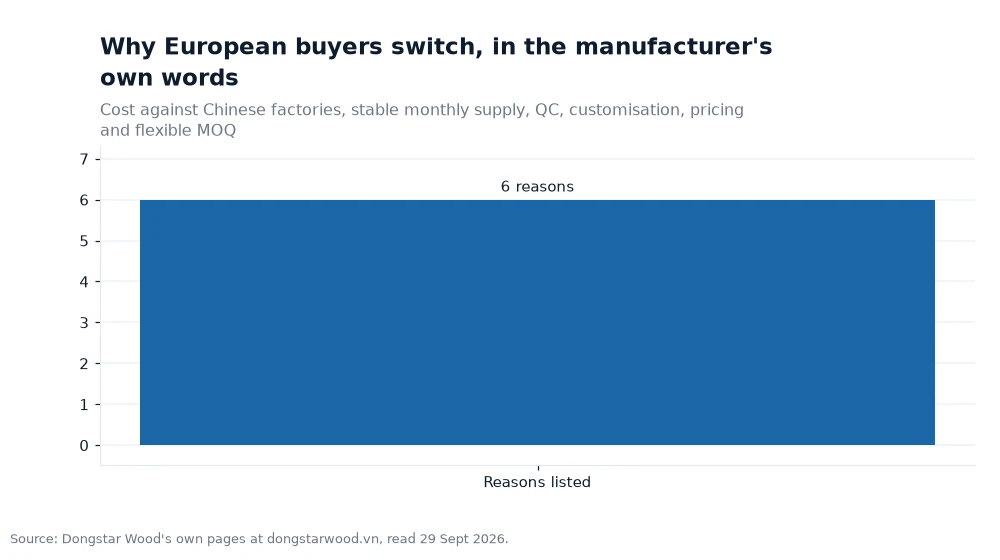
The manufacturer lists six reasons European buyers move to this supply: more affordable and cost-effective than Chinese factories; stable monthly supply; competitive pricing for EU wholesale distribution; custom size, core structure, glue, face veneer and grade; strong QC at each production stage; and flexible MOQ with fast delivery to Europe. The list is a useful checklist in reverse — a buyer can score a quotation against each point and see where the mill's published answers are strong and where they are thin. The banner on the category page adds the duty position: No Anti-Dumping Tax, stated alongside the FSC claim and the factory-direct price promise.
| Choice | Published option | Where it shows up |
|---|---|---|
| Face veneer | Birch, Pine, Bleached Poplar, EV, Rose Eucalyptus | The visible surface after finishing |
| Core | Acacia, Bodhi, Eucalyptus, Combi | Load, weight and cost of the panel |
| Thickness | 6–9 / 12–15 / 18 mm | Cabinet backs to structural panels |
| Glue class | MR, BWR | Dry interiors to humid rooms |
| Duty position | No Anti-Dumping Tax | EU market shipments |
Worked example: building a veneer-and-core matrix
Example only, using the published options. A buyer specifying Birch face on Eucalyptus Core at 12 mm for office furniture has fixed three of the five published variables; the remaining two — glue class and grade — decide the price band. Across the range, five face veneers and four cores give 5 × 4 = 20 face-and-core combinations before thickness, glue or grade are chosen. A hotel fit-out that standardises on one combination can then negotiate the whole programme against a single specification instead of dozens of small variations.
Frequently asked questions
Which face veneer should a furniture maker choose?
Choose by the finish the piece will wear. Birch and bleached poplar take paint and stain evenly, pine shows a warmer grain, engineered veneer reads uniform across a run, and rose eucalyptus adds a reddish tone for feature pieces.
How do the four cores differ?
Acacia Core is the high-strength hardwood option, Bodhi Core trades a little strength for stability and cost-performance, Eucalyptus Core is positioned as the maximum-strength choice, and Combi Core mixes species to balance strength, weight and cost.
What thickness does interior furniture need?
Let the component decide the gauge. Hidden parts — backs, drawer bottoms, partitions — take 6–9 mm; the visible furniture run takes 12–15 mm; anything structural takes 18 mm. Programmes that standardise usually land on 12 mm and 18 mm, the pair that covers the majority of a fit-out.
From veneer list to finished fixture
The face you choose is the face the customer lives with, so fix it before the core and the glue. The birch panels page shows how a single veneer behaves across grades and thicknesses, and the company profile confirms the factory footprint and the certification set behind every face on the list. Buyers who lock the veneer first tend to spend their budget on the core and the glue class, which is where the panel's working life is actually decided.
Statistics quoted above were sourced from the company's published web pages retrieved on September 29, 2026[1].