
Quality control in fragrance OEM and ODM is a chain of checkpoints from raw material intake to release, and every checkpoint has a record. For a haircare launch the chain carries two stations a fine fragrance programme does not: the base-interaction test, where the concentrate meets the shampoo or conditioner chemistry, and the packaging-interaction check, where the product meets the bottle. Build the checklist before you order, and the first bulk batch becomes a verification instead of a gamble.
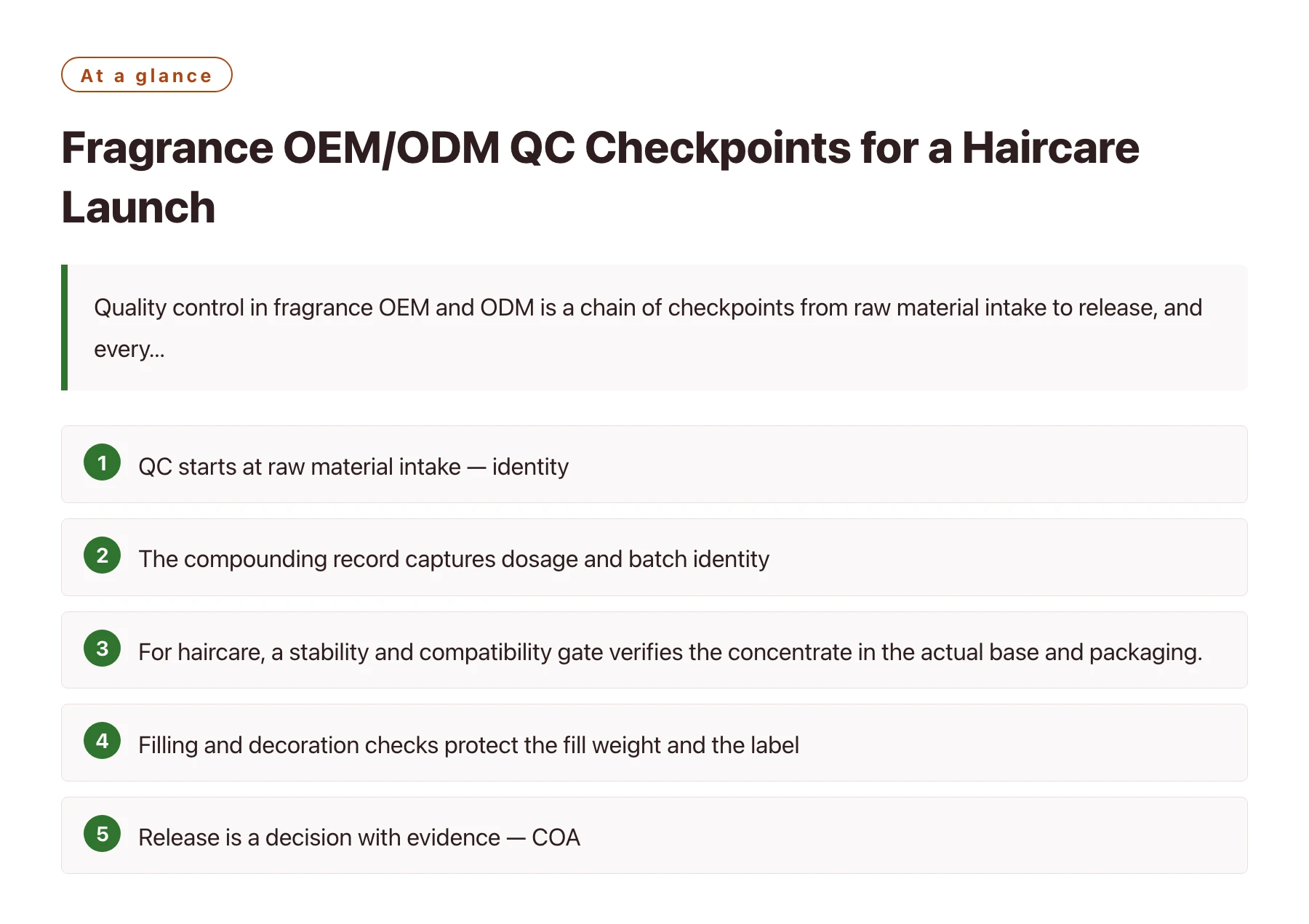
Key takeaways
- QC starts at raw material intake — identity, purity and restricted-material review — before anything is blended [1].
- The compounding record captures dosage and batch identity; it is the document that makes a batch reproducible.
- For haircare, a stability and compatibility gate verifies the concentrate in the actual base and packaging.
- Filling and decoration checks protect the fill weight and the label, where consumer complaints usually start.
- Release is a decision with evidence — COA, batch record and retained sample — not a signature on faith.
Inspection at the end is the most expensive way to discover a problem, and it is still where many small programmes stop. The alternative is a chain of checkpoints, each one cheap because it is early.
This article maps the checkpoint chain for a fragrance OEM/ODM project and marks where a haircare line differs from fine fragrance.
The checkpoints
| Stage | What is verified | Record produced |
|---|---|---|
| Raw material intake | Identity, purity, restricted materials [1] | Incoming inspection report |
| Compounding | Dosage accuracy, batch identity, mixing order | Compounding batch record |
| Base interaction (haircare) | Concentrate behaviour in shampoo, conditioner and leave-in bases | Compatibility report |
| Stability | Scent, colour and clarity over time; pack interaction | Stability report |
| Filling | Fill weight, seals, cleanliness | Fill line record |
| Decoration and labelling | Artwork match, allergen and ingredient declarations | Inspection record |
| Release | COA against specification, retained sample | Release certificate |
The first three checkpoints are where the money and the risk live; the last four are where the evidence must be complete. A programme that documents all seven can answer any buyer question about any batch.
The records behind the checkpoints
Batch records are the backbone
Traceability is the quality system: from raw material lot to filled unit, through weights, timings and deviations. A GMP-style framework and third-party laboratories exist to make that chain routine and verifiable [2].
Release criteria are set by the brand
The specification — dosage, fill weight, scent acceptance, label accuracy — is the brand's document, and the release decision compares the batch against it. A supplier that asks for the spec before quoting is a good sign; one that approves batches to its own unstated standards is a risk.
Packaging is a checkpoint with its own rules
In the EU, packaging rules extend into the product's life, and the direction of travel is toward recyclability and reporting commitments that the brand should plan early rather than discover at the label stage [3].
Where haircare QC differs from fine fragrance
The concentrate that shines on a blotter can behave differently in a shampoo base: surfactants, pH and water content change how the scent reads, and the change is not predictable from the fine fragrance file. The base-interaction test belongs in the brand's specification, not in the supplier's standard panel.
Leave-on formats add their own questions — the scent on hair after drying, the product's interaction with the scalp — which is why the haircare checkpoint list is never a copy of the perfume list. Write the extra stations explicitly; a supplier will run the panel you specify, not the one you assumed.
Writing the specification the checkpoints measure against
The checkpoint chain only means something if the specification is written first. Decide the acceptance rules before samples arrive: the dosage range, the fill weight tolerance, the scent acceptance test (who sniffs, against what reference, at what point in the product's life), and the label and decoration tolerances. A blank specification invites a friendly supplier to fill it with its own standards.
Two clauses belong inside the specification rather than in the small print: who receives the record of each checkpoint, and what happens when a checkpoint fails. The first decides whether the file is auditable; the second decides whether a failure becomes a conversation or a discovery.
If your QC budget is one line, spend it on the first three checkpoints: intake, compounding and base interaction. Catching an error there costs a kilogram of material; catching it at filling costs a batch; catching it on the shelf costs a launch.
Choosing a partner by its checkpoint discipline
The checklist is also a vetting tool. Ask a potential perfume OEM/ODM manufacturer to walk you through its last batch record from intake to release; the quality of that walk tells you more than any certificate page.
The manufacturer's own account — Xuelei OEM/ODM — describes the service scope and credentials on its public site, which is the kind of published detail that makes a first conversation concrete. And for a custom direction, the same discipline applies: bespoke fragrance development and production runs the identical checkpoint chain, with the brief serving as the first specification.
Sources
- IFRA Standards Library (International Fragrance Association) —— The IFRA Standards Library lists the restrictions the fragrance industry applies to individual fragrance ingredients, based on safety assessments; it is the reference point for compliant fragrance formulation.
- SGS: Cosmetics, Personal Care & Household Testing —— Testing, inspection and certification services for cosmetics and personal care, including microbiological, stability and safety testing aligned with cosmetics GMP.
- European Commission: Packaging Waste and the PPWR —— EU rules on packaging and packaging waste, including the Packaging and Packaging Waste Regulation requirements on recyclability and design.
Frequently asked questions
How many checkpoints is enough?
Enough that an error can be caught before it compounds: intake, compounding, base interaction, stability, filling, labelling and release cover the standard project. More stations are justified wherever a format adds risk — refills, leave-on products, new packaging.
Who should set the release criteria?
The brand, in the specification. The manufacturer executes against it; the brand owns the standard. A supplier that pushes back on written criteria is asking you to accept its unstated ones.
Can I audit a factory's QC without visiting?
Partially: ask for a recent batch record, the release certificates and the retained-sample register, then verify with a sample review or a third-party inspection. A physical audit remains the strongest check; records are the honest second best.
What is the difference between a COA and a batch record?
A certificate of analysis states that the batch met the specification, usually with test results; a batch record shows what was actually done — materials, weights, timings, deviations. Both belong in the file; they answer different questions.
When should the brand's own lab test?
At the milestones that decide market entry: development sign-off, pre-launch stability, and spot checks on bulk runs. The brand lab is the second pair of eyes on the release decision, not a replacement for the supplier's process.